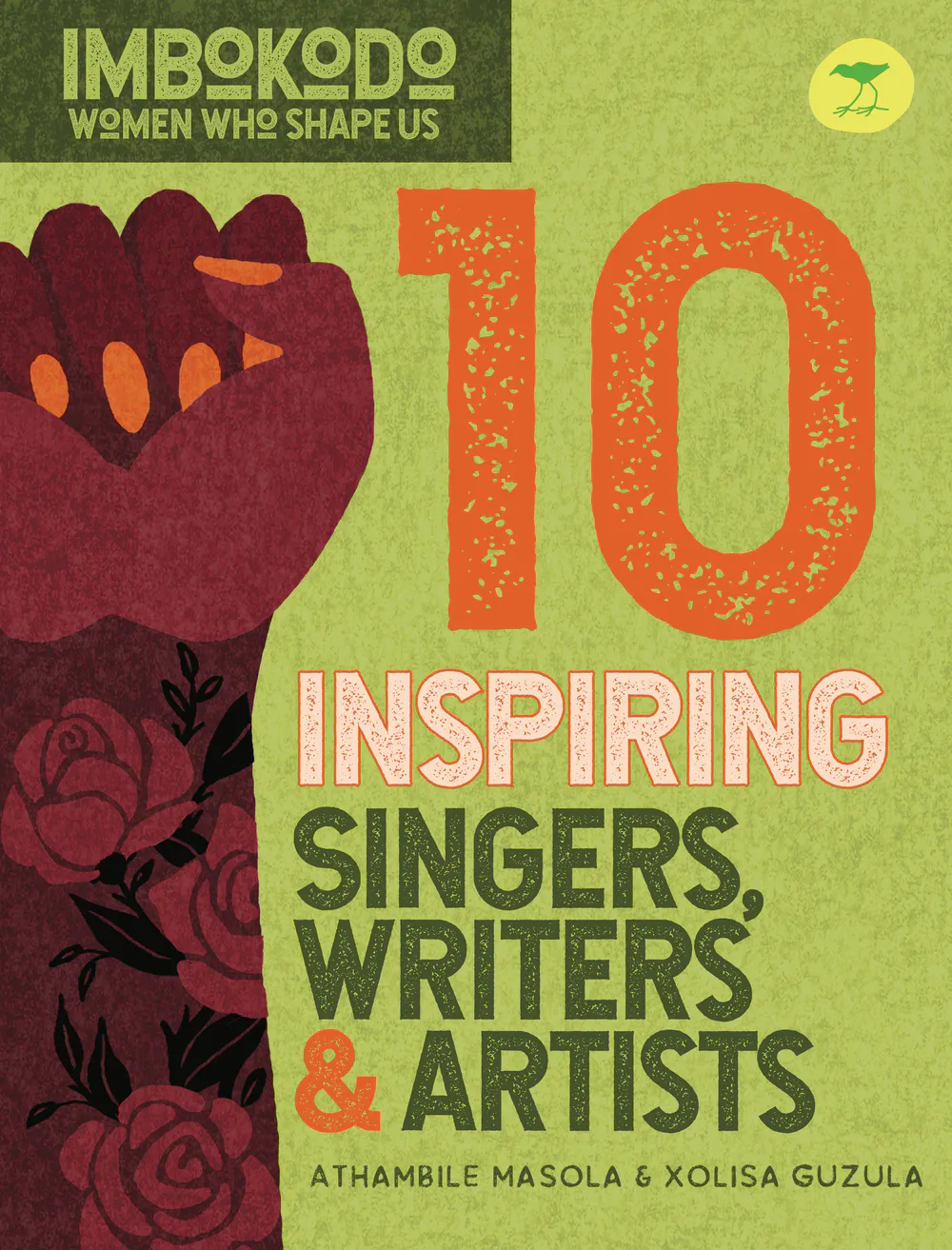
A new series of books called Imbokodo: Women Who Shape Us explores the neglected histories of South African women. Geared at younger readers, there are three books in the series: 10 Extraordinary Leaders, Activists & Protesters; 10 Inspiring Singers, Writers & Artists; and 10 Curious Inventors, Healers & Educators.
The authors are Xolisa Guzula, an early literacy specialist and children’s author, and Athambile ., a historian and poet. We asked them about the project.
What does Imbokodo mean?
Xolisa Guzula: Imbokodo is an isiZulu word that means “rock”. It’s often used in the saying, “Wathint’abafazi, wathint’imbokodo, uzakufa! Ubobhasopa!” (“You strike women, you strike a rock, you will be crushed! You should be careful!”) This was a chant used by women during the struggle for liberation in South Africa. As we know, the black women’s struggle is against racism, class and gender oppression.
The importance of the term lies in demonstrating that the strength of women comes in their collective and collaborative efforts. This is why we chose this word for our series. We see in these books how women worked with each other in building and shaping the society we now find ourselves in.
Athambile Masola: We felt it was important to feature stories of women who came before 1956. Without some of the work done in the early 1900s to build the women’s movement it is impossible to fully appreciate what happens in the 1950s. Evoking this symbol of imbokodo allows us to see our current struggles in relation to the past.
How have these women’s stories been told in the past, if at all?
Guzula: Our history and development is told from men’s perspective. We hear about how the men were heroes, intellectuals and pioneers. If their stories are told, women are shown as supporters to their men – like we hear that educator, author and politician John Langalibalele Dube started a school with his wife, Nokutela Dube, but her role is often not elaborated on.
Women are seldom shown as pioneers, inventors and creatives themselves. Patriarchal culture dictates that women use their marriage surnames such that their efforts add value to their husband’s lineage rather than their birth families. In Imbokodo we try to provide each and every woman’s maiden surname.
Secondly, women’s stories are told in a way that shows them as working alone, as the women they worked with are not always written about as part of their stories. This, of course, closes opportunities for further work of discovering, or surfacing what many other women might have worked on in collaboration with the women we write about.
The 1956 protest couldn’t have happened without collaboration. We also see how the women’s stories were interconnected. Masola: Women have also told their own stories through memoirs and essays. But much of the ways in which South Africa’s history is told is through political history and grand movements. Very little is written about how women are affected by wars, for example. The assumption is that the stories about war are the stories of men.
How did you make the selections for each of the books?
Masola: This was really tough. But it is important that people see our selections not as definitive but as ongoing. The historical figures were much easier than the contemporary figures because we had been collecting content for years. So we initially made a list of people who come to mind and have possibly not received as much attention in previous works, such as books such as Women Writing Africa.
Someone like school teacher Mina Soga is less well-known than scholar and activist Charlotte Maxeke, even though they were contemporaries. Even while there are a few more hyper-visible figures such as Maxeke and social worker and activist Madikizela-Mandela, it felt important to include them because they are the hook or entry point for some people insofar as how they understand women’s role in history.
Guzula: Athambile and I were part of a team that started a school for black girls, in Khayelitsha, Cape Town. Some of the women who inspired us are women who had started schools before us when conditions were even harsher.
They showed us the power of working with others and we wrote these books in collaboration, following in their footsteps. Nurses like Cecilia Makiwane and Dora Nginza, social workers such as Mam’ Mbeki, Mam’ Madikizela-Mandela, Brigalia Bam, Lilian Tshabalala, Sibusisiwe Makhanya and Maxeke showed us what community work involved.
What also inspired us was to see how these women worked in interdisciplinary ways and sometimes starting off by being teachers and then becoming change-makers.
We also wanted to include people who are custodians of our indigenous knowledge systems, such as musician Madosini, artist Esther Mahlangu and herbalist and midwife Louisa Mvemve.
Writing about them helps us to reclaim our humanity and being, our knowledge and ways of doing while also embracing new ways.
What do you want young readers to take away?
Athambile Masola: We hope that young readers will question the way they are taught history in schools. I hope that many of them will be curious about the stories that are yet to unfold, particularly in their own families. These books are an opportunity for young readers to sit and talk to their grandparents about their own stories.
Xolisa Guzula: It is important for children to see that women have agency and are able to take up powerful positions in society to build and shape their world and determine their future.
It’s official: 2022 is the year of the bombshell memoir. And A list celebrities are spilling the beans in new upcoming books.
While Perry’s upcoming tome will make for a seriously good read, Britney Spears and Prince Harry are preparing biographies of their own that will lift the lid on some of the greatest scandals of our time.
Spears has been given $21 million for her memoir, which will detail her recently terminated and controversial conservatorship, while Prince Harry’s “wholly truthful” tell-all will focus on the inner workings of the British royal family, the treatment of his wife Meghan Markle and his rarefied upbringing.
Royal expert Phil Dampier slammed the announcement, calling the estranged prince’s latest media move as a “nonstop roller-coaster” in the midst of the 95-year-old monarch’s private health battles and grief. Dampier told The Sun, “It just makes you wonder what’s coming next.”
American rapper and fashion designer Ye , commonly known by his birth name Kanye West has gotten social media talking about his "latest" poem.
West shared a new, controversial poem titled “Dead” just a couple of days after he posted another one titled “Divorce.”
In the poem, he writes about not realizing he’s deceased.
Captioning the poem on his Instagram, Kanye West declined to comment on the meaning behind it. Instead, he said, ‘explanation destroys the mystery and magic of true love and puts it in a box that can be counted.’
Though Kanye West’s work of art has been regarded as a masterpiece, the poem has left a number of people worried about his well being.
Some social media users have alluded that his two recent poems are a cry for help and have even suggested that he should go for therapy.
A young Botswana woman, Paula Otukile hosted the Mulher Forte African Literature Awards at the University of Botswana recently.
In an interview, Otukile said Mulher Forte was a Portuguese phrase simply meaning a strong woman. The Mulher Forte African Literature Awards (Pty) Ltd company was registered on September 8, 2020 and its aim is to give recognition to literature in Africa.
The company will create literature awards competition annually and interactive literature webinars, workshops and debates.
“I was inspired by the love of African narrative and saw the need in the book industry market to create a platform that can give literature recognition. African writers from all over the continent are eligible to partake in these awards.
"The rise of self publishing reduced the quality of books and let to a rise of more authors. Hence in Africa people write but do not gain anything out of it. Mulher forte was created to help reduce the rise of bogus publishers who scam people of their money online, so many young Africans can easily search reputable publishers from Mulher Forte African literature page on Facebook and publish,” she said.
She said Zimbabwe, Tanzania, Lesotho, Sierra Leone, Cape Verde, South Sudan, Zambia, Uganda, Botswana, South Africa, Namibia, Angola Swaziland, Kenya, Ghana, Nigeria, are part of the competition.
Otukile, however, explained that they intended to extend the invite to more African countries especially the francophone in the third annual awards. The awards are said to be strictly for only African writers as well poets and those
in the publishing industry because the aim was to unite Africa and improve the quality of performance and writing.
This year, Otukile pointed out that they did not find sponsors locally. She said they pitched at the Ministry of Youth Sports and Culture in Gaborone but were advised to apply at her home village, Mahalapye even though she already moved to Gaborone.
She, however, did not let that demoralise her, but she knocked on other doors.
Botswana National Library Services liked the project but there is delay in coming up with a working plan for the two. Writers Pen in Kenya, Read Us Africa Book Club in Uganda, Bothata Kennedy Silase Foundation in Lesotho offered different sponsorships.
South African author Amanda Buwa launched her debut book Bedroom Tears With My Therapist at the Mendi Arts Centre on Sunday afternoon.
Now 42 and raising a child of her own, Buwa’s upbringing was riddled with societal, mental and emotional challenges.
Growing up in a township where mental health was a taboo topic, the single mother said she saw the ripple effect in her 20s.
Buwa, who also found herself drowning in the cycle of alcoholism, shares her life experiences in her book, titled Bedroom Tears With My Therapist.
“I have gone through trials and tribulations that most girls in their 20s or even older are going through in their day-today life.
“Nonetheless, I remain a very positive, strong woman, who always believes in turning any negative situation into positivity,” Buwa said.
In her book, she details how her own alcoholism affected her life choices.
The writer further highlights the importance of therapy and the will to change one’s circumstances despite challenges.
“I also touch on the importance of seeking help to be able to transform to being a better individual, an individual who is mostly able to strive to be the best, and giving it all to remain positive.
“I know that in the black community it is seen as taboo to seek help and talk to a stranger about mental health,” she said.
Buwa said she wrote the book with the black community in mind and hoped to encourage parents to pay close attention to their children and create safe spaces for families to open up about their emotions.
In our continuing series, we share opportunities for those who wish to submit work be it poetry, prose, or other related arts in March 2022. These callouts are divided into journals, publishers, prizes, and education (MFAs, Fellowships, residencies).
Publishers
Narrative Landscape
Narrative Landscape Press is calling on suitable applicants for an eight-week internship. Successful candidates will work remotely & be paid a stipend.
Deadline: March 22 Details: On poster
Farafina
Farafina is one of the leading publishers based in Nigeria. They have made their annual call for submissions.
Call for submissions from artists and writers for a special edition of Omenana Speculative Fiction Magazine.
As we put pen to paper, it was literally raining coups in Africa.
From Sudan to Mali, from Burkina Faso to Equatorial Guinea to Niger, one hears either of violent truncation of government or an attempt at seizing the reins of power by gun wielding soldiers who purport to act for the greater good of the country.
Democracy, the system of governance that best serves the interest of the individual by allowing them a say in who governs them and how they are governed, is in peril. With this backdrop, Omenana Speculative Fiction Magazine in partnership with the National Democratic Institute (NDI) – a US-based non-governmental organisation that works to strengthen democracy – is calling for submissions for a special themed edition that explores positive visions of democracy.
Note that some of the stories in this special edition will form part of a global anthology edited by Dr. Amy Johnson in late 2022. Stories for the anthology will be selected from Omenana and two other great SF magazines from South America (Mafagafo and A Taverna) and an SF magazine based in Asia (Mithila Review).
Pan-African arts and literature collective, Jalada Africa, confirms Resistanceas the theme for Jalada 10 and opens its call for submissions.
Rooted in the Latin word resistere—to make a stand, to oppose, to be dissident—resistance evokes images: of Mandela at Robben Island bearing the dreams of his people, of Che at the beachfront in Havana framed by Alberto Korda; of a little girl reading Little Women by lamplight, defiant of Boko Haram and fundamentalist terrors; of Kenya’s Freedom Corner Mothers who staged a hunger strike and stripped down to stop senseless violence and secure the release of their sons detained as political prisoners; of young protesters across the globe united by a single banner–that #BlackLivesMatter; of the lonesome poet or painter locked down in this period of pandemics and upheavals, creating nonetheless. Deadline: Not indicated Details:Click here
Ipikai Poetry Journal
Ipikai a new online poetry journal, an initiative of the new Zimbabwe Poets Society open to Zimbabwean poets at home and abroad.
ArabLit Quarterly is a literary magazine that brings together Arabic literature, essays, wordplay, art, music, and food in translation, founded in 2018.
This issue will be guest-edited by Anam Zafar and Nadiyah Abdullatif. We are looking for writing in or about a JOKE, however that may be interpreted. Whether this is a literal knock-knock joke, or a meme, or a person who’s a joke, or a reflection on humor from the 10th century—we’re interested in it all. We are happy to accept a pitch as a submission.
TVOTRIBE is a community of proud and constantly evolving African Creatives. We focus on inspiring one another to becoming the best representation of Africa and changing the narrative of the African literary world.
A magazine of Nigerian criticism, we represent a space of literary discourse that is serious-minded and grounded in critical analysis. We are also a space for language to thrive and illuminate our minds, doing the following: book reviews, culture writing, popular writing, and literary criticism.
We are open for reviews and essays submission. We prefer reviews for mainstream literature Nigerian books. Essays can be on a wide-range of topics peculiar with the Nigerian (or African) art and literature sphere.
Shiwaki is short for Shirika La Waandishi Wa Lugha Ya Kiswahili which in English is the federation of writers in Kiswahili. If you wish to submit your writing in Kiswahili, here is your chance.
From the sandy shores of Senegal, to the backstreets of Mozambique, if you write short fiction, we want to hear from you. What exactly are we looking for?
Decolonial Passage presents each distinct piece of writing as a passage worthy of readers’ attention in which writers create texts to articulate a variety of themata affecting the human condition including, but not limited to authenticity, liberty, alienation, dignity, community, and boundless love. Decolonial Passage publishes writing from emerging and established writers who use language and form in innovative ways.
Olúmọ Review seeks amazing poetry – poetry that is bold, poetry that would collide with rocks and grind them to powder, that sparks curiosity, that intrigues the intellect, that kicks in the teeth, that guts the heart, that says something genuine about the world as well as the individual. We celebrate diversity and are open to diverse styles, forms, and kinds of poetry, about any and all subjects.
Nigeria Prize for Literature is a Nigerian literary award given annually since 2004 to honor literary erudition by Nigerian authors. The award rotates among four genres; fiction, poetry, drama and children’s literature, repeating the cycle every four years.
The prize this year will be handed out for poetry and will hand out 100,000 to the winner.
Created in 2017 as an avenue for fresh writers to showcase their manuscripts to the global literary community, and contribute their works to the canonisation of Africa literature, the Quramo Writers’ Prize celebrates unpublished writers who are working every day to hone their craft and record our continent’s original stories. The prize aims to encourage and stimulate a new community of talented writers, providing an opportunity for otherwise unexposed talent to achieve publishing recognition and encouragement.
For Quramo Writers’ Prize 2022, we are inviting unpublished African writers to submit an original manuscript in fiction prose, with a minimum word count of 30,000. An ‘African’ writer is taken to mean someone who is a citizen of an African country, or who has a parent who is African by birth or nationality, living anywhere in the world. The Prize is awarded to an original fiction prose manuscript by an unpublished African writer. ‘Unpublished is taken to mean the writer has never traditionally, digitally or self-published his writing in book format before. Each entry must be an original, unpublished work of fiction.
Now in its third year, the theme for this year’s edition of the Toyin Falola Prize is Freedom. However, freedom is conceived very broadly, for it means several things and can be several things too. It could be a physical condition, psychological, geopolitical, or even spiritual. Still, at the heart of the lexical item’s several interpretations is a roaming spirit, since to be free is to defy bounds: i.e., to have the capacity to not be pinned down. To what extent is this true or false? We want your story to answer this.
The 2022 BBC Young Writers’ Award with Cambridge University (YWA) is now open for entries. Now in its eighth year, the BBC Young Writers’ Award with Cambridge University invites all young people in the UK aged between 14-18 years to submit stories of up to 1,000 words.
Open to any children’s, YA or adult book published in 2021 by a UK author. Publishers can submit up to 5 books and self-published authors can submit up to 2 books.
The Hugo Award is the leading award for excellence in the field of science fiction and fantasy. The Hugos were first presented in 1953 and have been awarded every year since 1955 by the members of the World Science Fiction Society (Worldcon members) at the World Science Fiction Convention (Worldcon).
Nominations for the 2022 Hugo Awards, Lodestar Award for Best Young Adult Book, and Astounding Award for Best New Writer are now open.
International Publishers Association Prix Voltaire 2022
The Geneva-based International Publishers Association (IPA) has made a call for nominations for the 2022 IPA Prix Voltaire for exemplary courage in upholding the Freedom to Publish and enabling others to exercise their freedom of expression.
Exceptionally international in scope, the prize supports writers who have not yet published a book-length work, with no limits on age, gender, nationality, or background. The winners of each category will receive a £1,000 cash prize and publication, and will be published in Wasafiri’s print magazine. Shortlisted writers will have their work published on Wasafiri’s website. All fifteen shortlistees and winners will also be offered the Chapter and Verse or Free Reads mentoring scheme in partnership with The Literary Consultancy (dependent on eligibility), and a conversation with Nikesh Shukla of The Good Literary Agency to discuss their career progression.
The James Currey Prize for African Literature is an annual award for the best unpublished work of fiction written in English by any writer, set in Africa or on Africans in Africa or in Diaspora. It was established in 2020 by Nigerian writer, filmmaker and publisher of Hattus Books, Onyeka Nwelue, in honour of James Currey, the leading publisher of academic books on Africa – dedicated to distributing books about Africa in Africa.
University of East Anglia Writer Master Class (English and Kiswahili)
Are you in East Africa with a short story idea or an unpublished short story which could use some panel-beating from more experienced hands in the trade and possibly make it into an anthology? The University of East Anglia’s International Chair of Creative Writing Programme, led by Tsitsi Dangarembga invites you to submit your 2,000-3,000 word short story in English or Kiswahili to stand a chance to take part in a week’s residential Masterclass 4-9 July 2022 in Nairobi, Kenya to nairobisubmissions@gmail.com from now until Midnight on 9 May, 2022.
Story submissions in either of the two languages from writers based in Ethiopia, Kenya, Rwanda, Tanzania and Uganda will go through a first draft edit via email before final selection of participants who are expected to be in Nairobi during the week of the Masterclass at their own cost (we will make suggestions for low-cost accommodation). Participants in the Masterclass stand a chance of being published in two anthologies with Kiswahili stories translated into English and English stories translated in Kiswahili. The Masterclass that will be facilitated by Elias Mutani (Kiswahili) and Zukiswa Wanner (English) along with guest visits/readings from Tsitsi Dangarembga and the University of East Anglia’s director of Creative Writing and the International Chair programme Jean McNeil.